

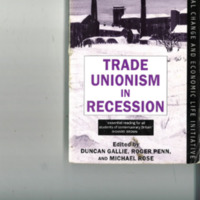
Trade Unionism in Recession
Title
Trade Unionism in Recession
Description
During the 1980s, British trade unionism confronted its greatest challenge, and suffered its greatest reverses, since the inter-war period. After a decade of rapid growth, the unions experienced a steep decline in membership, and virtual marginalization in national political affairs. By 1990 a previously united, self-confident social movement, as well as a powerful industrial bargainer, often seemed more closely akin to a demoralised collection of special interest groupings.
This book raises several fundamental questions raised by the record of these years. It examines the reasons for membership loss and the implications for trade union influence in the workplace. It looks at the steps the unions took in reaction to the membership problem and the difficulties they confronted in doing so. It also looks at whether this period can be seen as making a fundamental break with the past, resulting in an irretrievable loss by British trade unionism of its former important position in British society and the British workplace, or whether the past decade has been, but a temporary recession and the future can still see a revived movement.
This book raises several fundamental questions raised by the record of these years. It examines the reasons for membership loss and the implications for trade union influence in the workplace. It looks at the steps the unions took in reaction to the membership problem and the difficulties they confronted in doing so. It also looks at whether this period can be seen as making a fundamental break with the past, resulting in an irretrievable loss by British trade unionism of its former important position in British society and the British workplace, or whether the past decade has been, but a temporary recession and the future can still see a revived movement.
Creator
Duncan Gallie, Roger Penn, and Michael Rose
Publisher
Oxford University Press
Date
1996
Format
PDF
Language
English
Original Format
Paper
Files
Collection
Citation
Duncan Gallie, Roger Penn, and Michael Rose , “Trade Unionism in Recession ,” NCI Archive, accessed October 15, 2026, https://archive.ncirl.ie/items/show/1237.