

Radical Aristocrats: London Busworkers from the 1880s to the 1980s.
Title
Radical Aristocrats: London Busworkers from the 1880s to the 1980s.
Subject
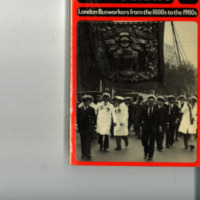
Londoon’s busworkers have long been famous for their industrial militancy, radical politics and the outstanding leaders produced by their rank-and-file organisations. Their history, from the ‘Red Button’ union – one of the very few in Europe to adopt a principled political opposition to the First World War – to struggles in the 1980s to preserve a decent transport service in London, is told in this graphic and stimulating book.
The busworkers’ union was one of those which came together in 1921 to form the Transport and General Workers’ Union under Ernest Bevin’s right-wing leadership. There were constant strains between Bevin and the capital’s busworkers, with the militants organised in the London Busmen’s Rank and File Movement which, with its paper Busman’s Punch, was seen as a model for left-wing activism in the unions, Bevin, however, ensured that when the busworkers struck in the famous ‘Coronation Strike’ of 1937 they did so on their own and were defeated; in the aftermath of the strike he conducted a purge of radicals in the London Bus Section which never recovered its earlier unity and militancy.
It was mass car-ownership after the Second World War which posed a major threat to public transport, and the post-war years witnessed a steady decline in London’s bus fleet and a loss of status by its workers. Frank Cousins’s left-wing leadership of the TGWU was central to the 1958 bus strike which, like the 1937 dispute, took place in isolation from other transport workers and was lost. Since then the capital’s bus service have declined still further and, with the abolition of London Transport and the GLC, London’s busworkers and the system they operate now face their most sever crisis ever.
The busworkers’ union was one of those which came together in 1921 to form the Transport and General Workers’ Union under Ernest Bevin’s right-wing leadership. There were constant strains between Bevin and the capital’s busworkers, with the militants organised in the London Busmen’s Rank and File Movement which, with its paper Busman’s Punch, was seen as a model for left-wing activism in the unions, Bevin, however, ensured that when the busworkers struck in the famous ‘Coronation Strike’ of 1937 they did so on their own and were defeated; in the aftermath of the strike he conducted a purge of radicals in the London Bus Section which never recovered its earlier unity and militancy.
It was mass car-ownership after the Second World War which posed a major threat to public transport, and the post-war years witnessed a steady decline in London’s bus fleet and a loss of status by its workers. Frank Cousins’s left-wing leadership of the TGWU was central to the 1958 bus strike which, like the 1937 dispute, took place in isolation from other transport workers and was lost. Since then the capital’s bus service have declined still further and, with the abolition of London Transport and the GLC, London’s busworkers and the system they operate now face their most sever crisis ever.
Creator
Ken Fuller
Publisher
Lawrence and Wishart
Date
1985
Format
PDF
Language
English
Coverage
1880s-1980s
Original Format
Paper
Files
Collection
Citation
Ken Fuller, “Radical Aristocrats: London Busworkers from the 1880s to the 1980s.,” NCI Archive, accessed October 15, 2026, https://archive.ncirl.ie/items/show/1235.